The Sulba Sutras: Ancient Foundations of Indian Geometry
| Title | The Sulba Sutras: Ancient Foundations of Indian Geometry |
|---|---|
| Author(s) | nidhi Nidhi Bhutada |
| Platform | Bharatiya Jnana Sarita |
| Categories | Mathematical, Physical and Astronomical Sciences |
| Year | 2026 |
| Type of Article | Original Article - Short Form |
| Difficulty Level | Beginner |
| Abstract | The Sulba Sutras are some of the world's oldest texts dedicated to mathematics and geometry. Part of the larger Kalpa Sutras (which deal with Vedic rituals), these manuals provide the specific geometric principles required to construct complex sacrificial altars, or vedis. The word Sulba (or Śulba) is derived from the Sanskrit root śulb, meaning "to measure." Historically, this referred to the measuring rope or cord (Rajju) used by ancient architects and priests to ensure perfect precision in their constructions. |
The Sulba Sutras: Ancient Foundations of Indian Geometry[edit | edit source]
The Sulba Sutras are some of the world's oldest texts dedicated to mathematics and geometry. Part of the larger Kalpa Sutras (which deal with Vedic rituals), these manuals provide the specific geometric principles required to construct complex sacrificial altars, or vedis. The word Sulba (or Śulba) is derived from the Sanskrit root śulb, meaning "to measure." Historically, this referred to the measuring rope or cord (Rajju) used by ancient architects and priests to ensure perfect precision in their constructions.
What are the Sulba Sutras?
While many of these ancient manuals have been lost over time, nine specific Sulba Sutras are recognized by historians and scholars today:
Baudhāyana Sulba Sutra: The oldest and most comprehensive.
Āpastamba Sulba Sutra: Notable for its detailed geometric proofs.
Kātyāyana Sulba Sutra: Contains more concise aphorisms and rules.
Mānava Sulba Sutra
Maitrāyaṇa Sulba Sutra
Vārāha Sulba Sutra
Vādhula Sulba Sutra
Laugākṣi Sulba Sutra
Hiraṇyakeśin Sulba Sutra



Key Mathematical Principles
The Sulba Sutras are not just religious texts; they are sophisticated mathematical treatises that predate many "Western" discoveries by centuries.
The Theorem of the Square on the Diagonal: Long before Pythagoras, the Baudhāyana Sulba Sutra explicitly stated: "The diagonal of a rectangle produces both areas which its length and breadth produce separately."
Approximating sqrt root of 2: To build altars of precise sizes, these texts provided a rational approximation for the square root of 2 that is accurate to five decimal places.


√2 ≈ 1 +1/3 +1/3*4 - 1/3*4*34
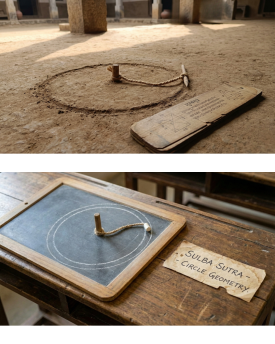
Squaring the Circle: They developed methods to transform a square into a circle of the same area (and vice versa), a problem that fascinated mathematicians for millennia.
The Gnomon and Shadow: Using a vertical pole (Śaṅku) and its shadow, they established the exact cardinal directions (East, West, North, South) with remarkable accuracy.
Why Are They Important Today?
The legacy of the Sulba Sutras extends far beyond ancient rituals. They remain highly relevant for several reasons:
Pedagogical Tool: They offer an alternative, intuitive way to teach geometry. Instead of rote memorization of formulas, the "rope and nail" methods help students visualize how shapes relate to one another.
History of Science: They serve as a primary record of India's long-standing tradition of rigorous scientific inquiry and architectural engineering.
Linguistic and Computational Interest: For those interested in Sanskrit Computational Linguistics, the structure of these sutras (short, logical aphorisms) is remarkably similar to modern coding logic and algorithms.
Indian Knowledge Systems (IKS): As India looks to integrate traditional knowledge into modern education, the Sulba Sutras provide a perfect bridge between ancient wisdom and modern STEM subjects.
Word Count: 627